
Your AI content is missing a pulse
The 3-layer system for writing that actually connects

The Problem Nobody Talks About
You’ve read AI-written content. You know the feeling.
Technically correct.
Well-structured.
Completely forgettable.
You scroll past it.
You don’t share it.
You definitely don’t remember who wrote it.
Here’s the thing: your readers can feel when something’s hollow. They can’t always articulate it. They just... leave.
The Three Layers of Content
I think about content in three rings:
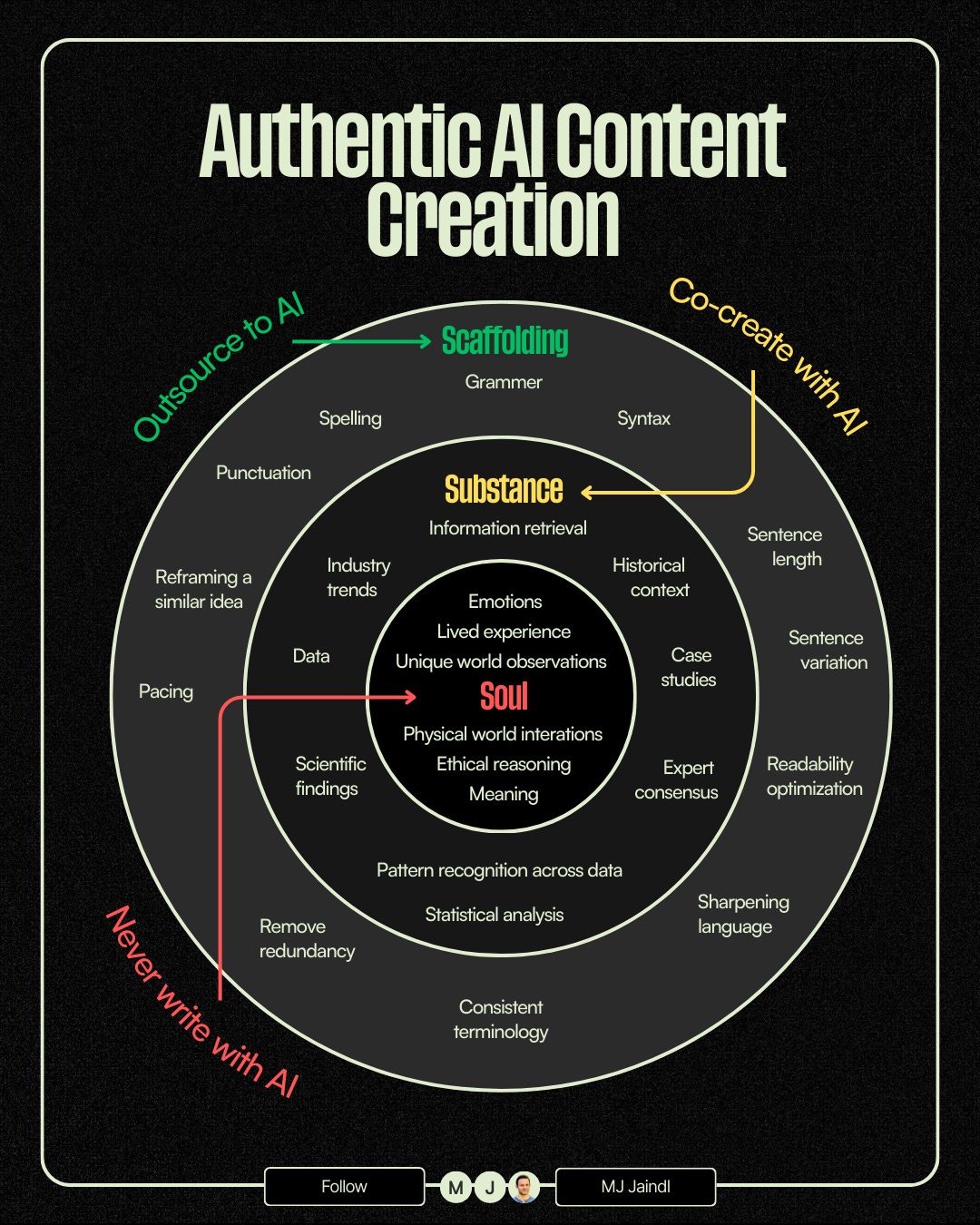
Scaffolding — Grammar, spelling, syntax, sentence flow, formatting. The mechanics. Outsource this to AI.
Substance — Research, data, case studies, expert consensus, historical context. The proof. Co-create this with AI.
Soul — Your emotions, lived experience, unique observations, ethical stance, meaning. The you. Never let AI write this.
Most people get this backwards.
They outsource the soul (”Write me a LinkedIn post about leadership”) and manually fix the scaffolding.
Flip it.
Why Soul Can’t Be Automated
Here’s what I mean by soul:
It’s the anger you felt when you watched a client get bad advice, and that’s why you’re writing this post.
It’s the specific moment you realized everything you believed about your industry was wrong.
It’s the opinion you’re nervous to share because it might alienate half your audience.
AI doesn’t have that. It can’t.
It hasn’t sat in a meeting where someone said something that made your stomach turn. It hasn’t had the 2am realization that changed how you work. It doesn’t know what hill you’re willing to die on.

This meme exists because a human watched that movie, understood the cultural moment, felt the tension between Will Smith and that robot, and thought: “yeah, that’s exactly how that conversation would go.”
AI couldn’t have made this. It doesn’t have the comedic timing. It doesn’t get why the reversal hits. It doesn’t know what’s funny. It only knows what’s been labeled funny before.
Humor. Timing. The ability to make someone snort-laugh at their phone.
That’s soul. Good luck prompting your way there.
Readers Feel Energy. Even Through a Screen.
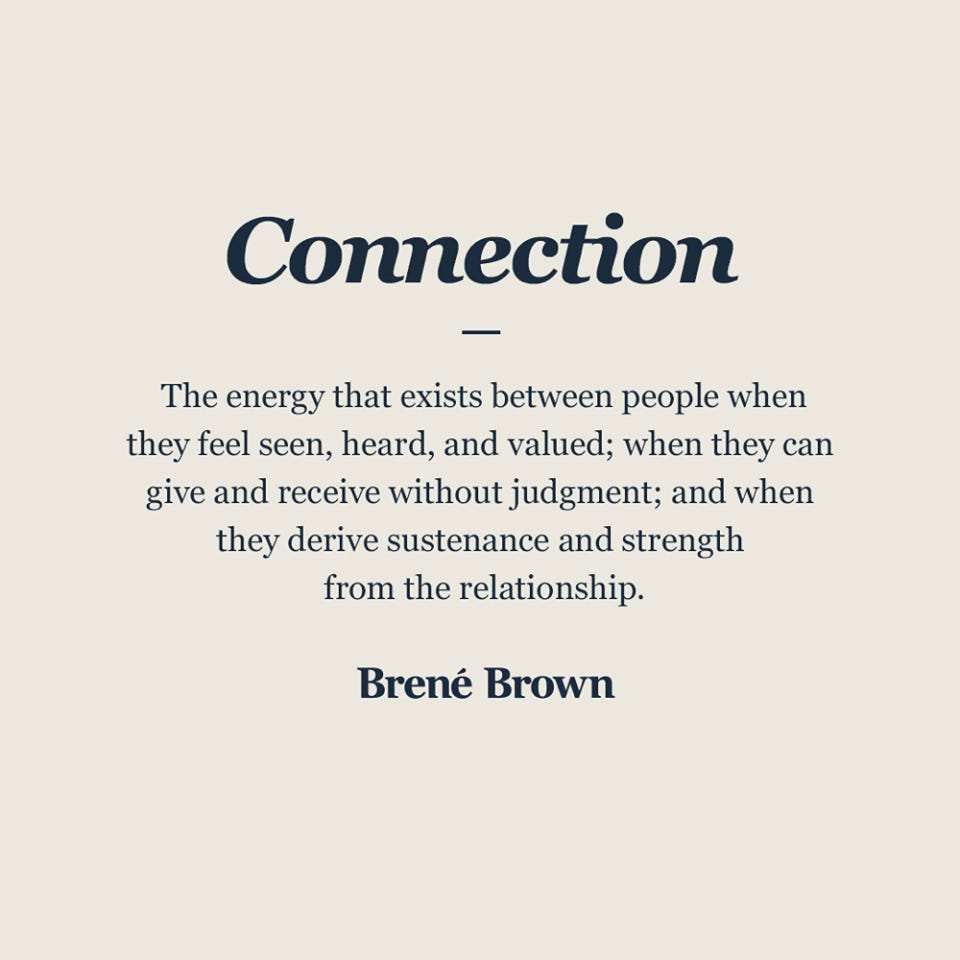
“The energy that exists between people when they feel seen, heard, and valued; when they can give and receive without judgment; and when they derive sustenance and strength from the relationship.”
That’s what Brené Brown says about connection.
Now read that again, but think about your content.
Your readers want to feel seen. They want to feel like you get them. They want to walk away stronger than when they showed up.
AI can’t create that. It doesn’t know your reader. It doesn’t care about them. It’s optimizing for engagement, not connection.
When you write from a real experience, you choose different words. Your sentences have a different rhythm. You include the weird, specific detail that you’d normally edit out, the one that makes a stranger think “wait, that happened to me too.”
That’s the energy. That’s the connection.
And connection is the only reason anyone remembers anything they read.
Think about the posts that stuck with you. The ones you screenshot. The ones you send to a friend with “this is exactly what I was trying to say.”
Those weren’t optimized for readability. They were written by someone who felt something and couldn’t not write it.
The Danger of “Good Enough”
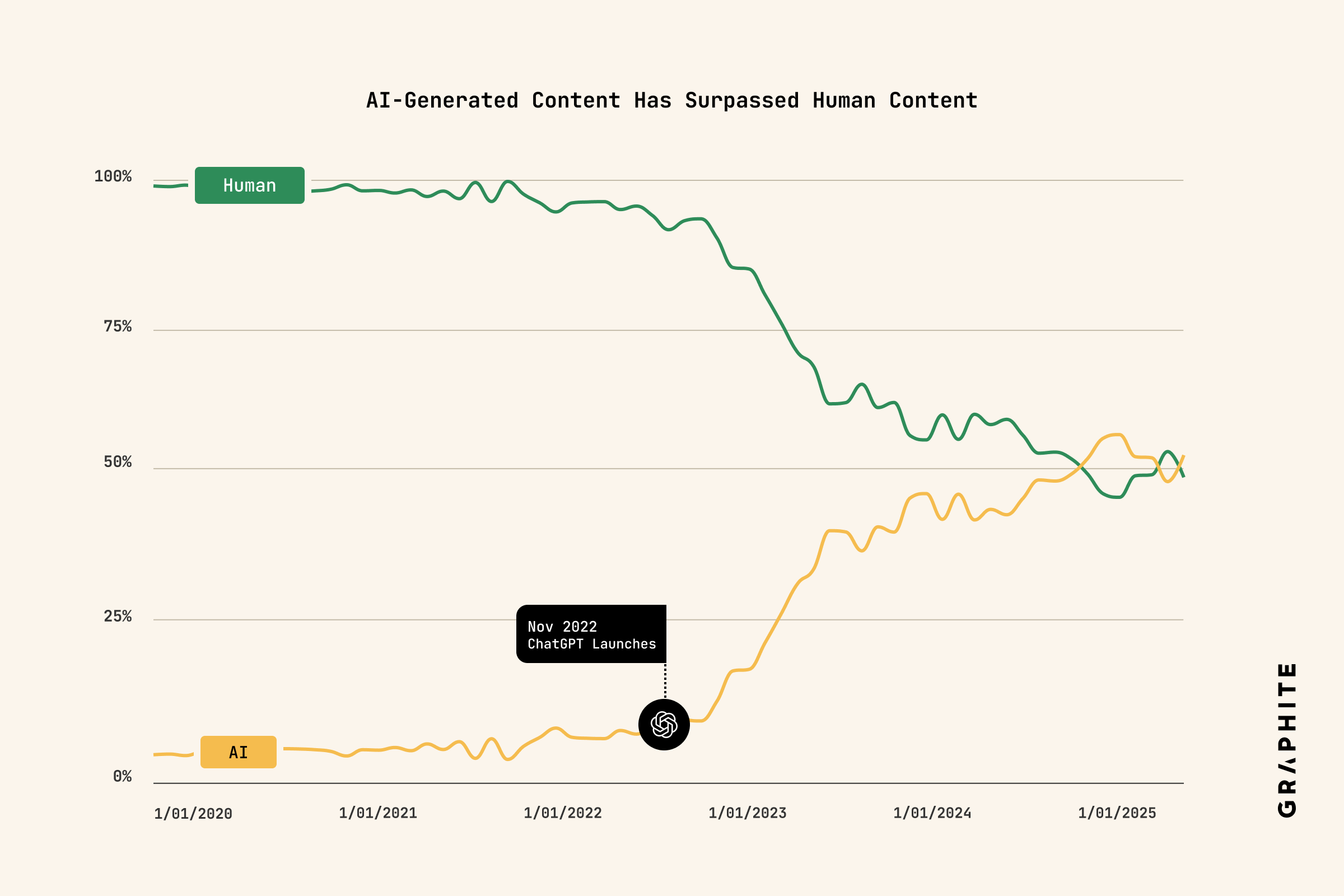
Look at that crossover point.
Since ChatGPT launched in November 2022, AI-generated content has gone from near zero to roughly half of everything being published. Human content, the stuff written because someone had something to say, is now the minority.
This is the new reality: AI makes it easy to publish content that’s... fine.
Coherent. On-topic. Reasonably engaging.
But “fine” is invisible now. “Fine” is the default. “Fine” is what half the internet already looks like.
The bar for content is no longer “well-written.” Everyone, and every bot, can do that.
The bar is: does this feel like a human wrote it because they had to?
When the feed is 50% AI slop, the stuff with a pulse stands out like a flare.
How to Actually Use AI (Without Losing Your Voice)
Outsource the scaffolding. Grammar, cleanup, tightening sentences — AI is great at this. Let it.
Co-create the substance. Need data? Historical context? Counter-arguments? AI can research. You interpret.
Never outsource the soul. Your stance. Your story. Your specific, weird, human observations. Write those yourself. Then let AI polish them.
5 Prompts to Keep Your Content Human
Use these to write with AI without losing what makes your content yours:
1. Soul Mining (before you write anything)
“I’m writing about [topic]. Ask me questions to uncover: what personal experience shaped my view, what emotion I want readers to feel, and what belief I hold that might be controversial.”
2. Moral Stance Check
“Here’s my draft: [paste]. What ethical position am I implying? What am I saying is right or wrong? If I’m not taking a stance, push me to pick one.”
3. Substance Assist
“I’m arguing [your point]. Find me 3 data points, historical examples, or expert perspectives that support OR challenge this. Don’t hide the counterarguments.”
4. Voice-Preserving Edit
“Edit this for clarity and flow. Keep my sentence fragments, my weird analogies, my tone. Only fix what’s genuinely unclear. Flag anything you’re tempted to ‘professionalize’ but don’t change it.”
5. Authenticity Audit
“Read this draft. Highlight any sentence that sounds like it could’ve been written by anyone. Those are the ones I need to rewrite myself.”
The Bottom Line
The best AI content isn’t AI content.
It’s your content. Your energy, your experience, your stance … with AI handling the parts that don’t require a pulse.
Your readers don’t want polished. They want real.
Give them that.
Happy Saturday!
MJ ✌️